English
Analogion

Hi, I’m Gabriel.
I’ve been composing Byzantine music settings in English for over a decade, and I started a previous version of this website (EnglishMenaion.com) as a way to easily share my work with others who use Byzantine chant in their celebration of the divine services of the Orthodox Church. However, I’m not the only person doing this work, and so I created EnglishAnalogion.com as a repository for traditionally-composed English-language scores and other liturgical resources from various composers and translators who have also dedicated themselves to the liturgical life of the Church.

I began formally studying Byzantine Chant when I enrolled in the undergraduate Theology program at Hellenic College Holy Cross Greek Orthodox School of Theology in Brookline (a suburb of Boston), MA. During this time, I studied for four years with Dr. Grammenos (now Fr. Romanos) Karanos, a student of Photios Ketsetzis and the assistant professor of Byzantine chant at this institution. It was Fr. Romanos who first awakened in me an interest in Byzantine chant composition when, in a class on Plagal 1st Mode, he assigned each of us to compose a piece in the mode we were studying. The result of this assignment was my first composition, a doxastikon for St. Sophia and her three daughters, who are commemorated on September 17th.
During my time in Boston, I was also blessed to receive additional lessons in Byzantine chant and/or composition from John Michael Boyer, Fr. Maximos Constas, and Papa Ephraim of St. Anthony’s Monastery. It was also during this time that I first made the acquaintance of Dr. Ioannis Arvanitis, Mr. George Hatzichronoglou, and the Monastery of the Archangels (“Moni Petraki”) when I spent a semester abroad in Athens, Greece with the College Year in Athens program in 2012.


In May of 2014, I graduated from Hellenic College with an undergraduate degree in Theology, a minor in modern Greek, and a certificate in Byzantine Music.
After graduation, I took a one-month trip to Mount Athos, during which time I stayed at the Monastery of Simonopetra and spent my time praying about what direction to take next in my life. The abbot of Simonopetra, Elder Elissaios, graciously spent an evening offering his advice and counsel on this topic, and offered to find me housing in Athens, Greece, so that I could undertake studies in Byzantine Music composition with the aforementioned Dr. Arvanitis. After this one-month stay on Mount Athos, I returned to the United States, was offered a part-time job at Hellenic College Holy Cross as a lecturer in Byzantine Music, and spent the next fourth months preparing to move to Greece.

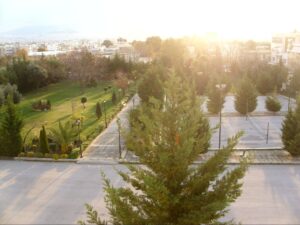
In January of 2015, after receiving a letter of recommendation from Metropolitan Nicholas of Mesogaia, I flew to Greece and moved into a dormitory located in Aigaleo (a suburb of Athens) and operated by Apostoliki Diakonia (a ministry arm of the Church of Greece). I lived there for several months before moving into a small apartment located closer to the University of Athens.
Sooner after moving to Greece, I commenced my studies with Dr. Arvanitis and Mr. Hatzichronoglou, focusing on the performance on Byzantine musicology and composition with the former, and Byzantine chant performance with the latter. I also enrolled in a 5-month intensive modern Greek language course at the University of Athens and completed the Γ1 level.

While living in Athens, I was hired as the left chanter (lampadarios) at the church of Saint Marina in Thiseio, and also worked as a third chanter at the church of Saint Gerasimos in Ano Ilisia.


In January of 2016, I proposed to Elaine Theophania Van Sickle, and returned to the United States. We were married sooner after and moved to Lancaster, Pennsylvania, where I worked part-time as the head chanter of Annunciation Greek Orthodox Church under Fr. Hector Firoglanis. During this time, I also worked part-time at an engineering firm and commenced classes in an undergraduate program to work on a second bachelor’s degree, this time in engineering.
However, not long afterward, Fr. Conan Gill, the presiding priest of St. George Greek Orthodox Church in Albuquerque, NM, offered me a full-time job as music director and head chanter of his parish - a parish which, under the leadership of Chris Gianopoulos, had celebrated its services entirely in Byzantine chant for decades. After much prayer, my wife and I decided to move to New Mexico, and I started my new job there in February of 2018.

Since then, I have worked full-time in the world of Byzantine Chant, and have partnered with the following individuals, groups, and institutions (although this list is not exhaustive) in various capacities:
- The Archdiocesan Byzantine Choir under the direction of Demetrios Kehagias
- The Greek Orthodox Metropolis of Boston "Saint John of Damascus" Byzantine Music School
- The Saint Raphael School (one of the largest online Orthodox Christian schools in the United States), where I started their Byzantine chant program
- The Digital Chant Stand of the Greek Orthodox Archdiocese of America (formerly AGES Initiatives under Fr. Seraphim Dedes)
- The Dynamis Byzantine Ensemble, of which I have served as the assistant director since its foundation in 2018, and with which I have recorded several CDs, either as a choir member or director
- The Liturgical Arts Academy, where I have taught since 2019
- The Trisagion School of Byzantine Music, which I co-founded with Samuel Herron and Amy Hogg in 2020
- The School of Byzantine Music of the Greek Orthodox Archdiocese of America under the direction Georgios Theodoridis
- And numerous individuals and parishes throughout the country, for whom I have taught private lessons and group classes, led workshops, and composed musical settings by commission



Dr. Nicholas Roumas
Dr. Roumas is a contributor of both musical scores and translations to EnglishAnalogion.com. An accomplished cantor and translator, he is the composer of The Musical Ark and a modern English translation of the Psalter. He teaches Byzantine Music at the School of Byzantine Music of the Greek Orthodox Archdiocese of America and is currently finalizing a modern English translation and musical setting of the Anastasimatarion.

Phillip Phares
Phillip is a contributor of both musical scores and translations to EnglishAnalogion.com. He is most interested in the old sticheraric style of composition, the study of the old notation of Byzantine chant, and the Greek language. Phillip serves as the head chanter of St. Joseph Antiochian Orthodox Church in Houston, TX.

Samuel Herron
Samuel has been studying Byzantine chant since 2002 and has learned from several masters of the Psaltic Art. He contributes a number of scores to EnglishAnalogion.com, and serves as the full time Director of Music Ministry at St. Nektarios Greek Orthodox Church in Charlotte, NC. He is also the director of the Dynamis Byzantine Ensemble and a co-founder of the Trisagion School of Byzantine Music.

Peter (Panagiotis) George
Peter contributes to EnglishAnalogion.com primarily as a translator and researcher of the typikon (order of services). He serves as the leader of the left choir (lampadarios) at St. Mark’s Cathedral in Westwood, MA, and also teaches several classes on the typikon at the Trisagion School of Byzantine Music.

Kamal Hourani
Kamal contributes to EnglishAnalogion.com primarily as a translator of liturgical services, especially services for newer saints or for saints whose services are not included in the standard Menaia. His first published translations can be found in the book Joyful Light: Saint Haralambos, published by Zoë Press. He also teaches beginning and intermediate-level classes at the Trisagion School of Byzantine Music.

Ioannis Arvanitis
Dr. Arvanitis is one of the foremost researchers and composers in Byzantine chant musicology currently active in the world today. He has composed several original scores in English, and his work serves as an inspiration for much of the material contained on English Analogion.
Grammenos Karanos, PhD
Originally published as “A Brief Overview of the Psaltic Art,” Introduction to Garinis, Aristidis, and Kehagias, Demetrios, Byzantine Music Theory and Practice, Greek Orthodox Archdiocese of America, New York 2011, pp. iii-xi.
A Brief Overview of the Psaltic Art
“Is any among you afflicted? Let him pray. Is any merry? Let him sing psalms.”
(James 5:13 KJV)
As is evident from St. James the Brother of the Lord’s exhortation, the history of the Christian Church has always been not only a history of prayer, but also a history of song. If in some contemporary Christian denominations music plays a secondary role, it would be no exaggeration to state that in the Greek Orthodox Church almost all of worship is musical. And how could it be otherwise if “chanting is an angelic ministry for [it] gives joy, but it is also prayer?[1]” Following the ancient Greek philosophers Plato and Aristotle, the Fathers of the Church recognized the beneficial impact music can have on souls and adopted it as an important pedagogical tool to lead humans to eternal salvation. St. Basil the Great expresses the Church’s attitude in very clear terms:
“For when the Holy Spirit saw that mankind was ill-inclined toward virtue and that we were heedless of the righteous life because of our inclination to pleasure, what did he do? He blended the delight of melody with doctrine in order that through the pleasantness and softness of the sound we might unawares receive what was useful in the words, according to the practice of the physicians, who, when they give the more bitter draughts to the sick, often smear the rip of the cup with honey.”[2]
Music then is the “sweet honey” with which the Church mixes the doctrines of the faith, in order to heal the sick souls of the faithful. It is through these lenses that the Psaltic Art of the Greek Orthodox Church ought to be viewed. In the present article, whose aim is to highlight the significance of the present publication, I will give a brief overview of this fine art, focusing on its essential characteristics, its composers and practitioners, its notational system, and the didactic methodology used by its teachers throughout history.
- Definition - Characteristics
An American reader will naturally ask what exactly is the Psaltic Art. A very simple albeit limited definition is that it is the art of chanting[3]. More broadly, it can be defined as the strictly vocal, strictly monophonic music used in the worship of the Greek Orthodox Church[4]. Before looking at this definition more closely, let’s consider an alternative term, namely “Byzantine music.” Despite its common usage since the 19th century, it should not be the preferred term for three reasons. First, the inhabitants of the Eastern Roman Empire never referred to themselves as Byzantines, but as Romans (Ρωμαίοι-Ρωμηοί). The term “Byzantine Empire” itself was invented in the 16th century by the German historian Hieronymus Wolf and later took on derogatory connotations[5]. Second, “Byzantine music” can be interpreted in an overly restrictive fashion if it is considered in topological or chronological terms. In other words, it may be taken to mean the music produced only in Byzantium or the music produced strictly from the foundation of the Byzantine Empire in 330 AD until its fall in 1453 AD. On the other hand, the term “Byzantine music” might more appropriately be applied to the entire musical output of the Eastern Roman Empire, both religious and secular. Nevertheless, secular music is generally excluded from the contemporary usage of the term. Third, the musicians of this once glorious Greek-Roman-Christian empire did not call their art “Byzantine music,” but rather Psaltic Art (Ψαλτική Τέχνη), Musical Art (Μουσική Τέχνη), Musical Science (Μουσική Επιστήμη) or Papadic Art (Παπαδική Τέχνη)[6].
Let’s move on to dissect the definition given above. The Psaltic Art is strictly vocal. This means that it is a form of music always performed a capella. Instruments were excluded from worship since early Christian times because they were associated with pagan rites, but also because the voice was regarded as the most pure and perfect instrument. Additionally, instrumental music was believed to excite the senses and was consequently considered unsuitable for worship. The Psaltic Art is also strictly monophonic. In other words, it is performed by a single cantor or a choir singing one melody in unison. A few qualifying remarks should be made here. Polyphony was introduced in Greek Orthodox worship as early as the 15th century, but its usage remained very limited except in the Ionian Islands. In the mid-19th century polyphonic settings of ecclesiastical melodies appeared in Greek diaspora communities in Western Europe, despite an official promulgation by the Ecumenical Patriarchate in 1848 of an encyclical banning four-part harmony[7]. In the 20th century harmonized settings of hymns were adopted in the Divine Liturgy in the Greek Orthodox Archdiocese of America. Nonetheless, the original monophonic version of the Psaltic Art, which is almost exclusively used in other Greek-speaking Orthodox Churches (Patriarchate of Jerusalem, Church of Cyprus, Church of Greece, et al.), has remained the norm in the rest of the liturgical services. It should also be noted that psaltic melodies are frequently accompanied by the ison (drone), which is a constant humming of a single note (the root of the main tetrachord in which the melody is moving). This century-old practice[8] is sometimes considered a form of proto-polyphony. However, its primary function seems to be tonal stability rather than “harmonic” enrichment of the melody. Thus, even though it may enhance the aesthetic satisfaction of a performance, ison accompaniment is not an indispensable element of a psaltic composition.
In addition to vocal performance and monophony, the Psaltic Art has the following fundamental characteristics:
- Primacy of the word versus the music. Music is used as a means to express and illuminate the meaning of the text. Even though it is certainly meant to provide a degree of aesthetic pleasure to the listener, its primary role is to contribute to a prayerful atmosphere in worship. Therefore, excessive musical embellishment is seen as detrimental and distractive.
- Microtonal intervals. Intervals that are smaller than the western semitone are frequently used. In fact, it is primarily this microtonal quality that makes the Psaltic Art sound foreign and exotic, hence strangely attractive to the modern American ear. The existence of microtones is closely related to the tendency of the structural notes of a scale (generally, the root and upper note of a tetrachord) to attract the non-structural ones, which consequently display a tonal instability.
- Modality. Psaltic compositions do not conform to the western major and minor scales, but rather to the eight Byzantine authentic and plagal modes and their numerous variants. A mode is defined by the tonic, the scale, the genus (i.e. the intervallic internal structure of the tetrachords and pentachords), and the melodic formulae and cadences, and can easily be identified by the intonation formula that precedes any hymn.
- Formulaic composition. All psaltic compositions are built from pre-existing melodic formulae, called theseis, which are combined with short transitional bridges. Theseis can be short, long and even very elaborate and melismatic, depending on the particular compositional genre to which a hymn belongs. One might wonder how there can be any originality in the Psaltic Art if a hymn cannot be composed out of entirely new material. The answer lies in the very large number (thousands) of theseis, the difference in their particular musical content depending on the mode and the starting note on which they are placed, and the infinite number of ways in which they can be combined to produce a new acoustic experience. Additionally, throughout the history of the Psaltic Art composers kept composing new theseis, thereby renewing and enriching the material that later composers would have at their disposal[9].
- Composers – Cantors
A quick glance into the manuscript tradition of the Psaltic Art immediately reveals that its history is full of eponymous and anonymous personalities from all walks of life: saints and sinners (or self-proclaimed sinners out of humility), hymnographers, composers and scribes, teachers and disciples, patriarchs and bishops, priests and deacons, cantors and readers, monks and nuns, jewellers and merchants, fishermen, painters, schoolmasters, tailors. Among them all the most prominent position belongs to the over 1,000 composers who almost always were also cantors and to the tens of thousands of cantors who often were also composers. Let’s look at some of them.
St. Romanos the Melodist (6th c.)
Romanos was born in Syria and flourished in the 6th century. He served as a deacon in Beirut and Constantinople. He is considered the greatest Orthodox hymnographer of all time and has often been called “the Christian Pindar.” Some 85 surviving kontakia[10] are attributed to him. The title “melodist” indicates that he not only wrote the hymns, but also composed their music. The Orthodox Church celebrates his memory on October 1.
St. John of Damascus (ca. 676 – 749)
A Syrian hieromonk and a brilliant theologian and defender of the veneration of icons, John is also regarded as the “Father of Byzantine Music” and patron saint of cantors. He was a prolific composer and was largely responsible for the codification and standardization of the system of eight modes (Octoechos), according to which the yearly cycle of liturgical services of the Orthodox Church is arranged. The Orthodox Church celebrates his memory on December 4.
St. Ioannis Papadopoulos Koukouzelis (ca. 1270 – ca. 1340)
Once an imperial musician and later an Athonite monk, Ioannis is perhaps the greatest figure of the Psaltic Art. He was the disciple of Ioannis Protopsaltis the Sweet and a fellow student of Xenos of Koroni. These three composers along with Nikeforos Ethikos constitute the “tetrandria” that solidified the new kalophonic style of ecclesiastical music[11]. The defining characteristics of this highly ornate style, which had its beginnings in the late 13th century, are (i) long, melismatic melodies, (ii) restructuring of the poetic text, and (iii) insertion of kratimata, i.e. free compositions using meaningless syllables (e.g. terirem, tenena, tototo, etc.) as “text.” Koukouzelis’ name first makes its appearance in MS. Leningrad 121 written in 1302. The admiration of contemporary and later musicians for the great composer is shown by the title “Maistor” (i.e. Master) that almost unfailingly follows his name. It was probably under his guidance that one of the most significant manuscripts in the history of the Psaltic Art, namely MS. Athens 2458, was composed in 1336. The Orthodox Church celebrates his memory on October 1.
Manuel Doukas Chrysaphes (15th c.)
Manuel Chrysaphes was the last Lampadarios[12] of the imperial palace prior to the Fall of Constantinople in 1453. His autograph, MS. Iviron 1120, written in 1458, is a monumental anthology of works marking the transition from the Byzantine to the post-Byzantine period of the Psaltic Art. His theoretical treatise “On the theory of the art of chanting and on certain erroneous views that some hold about it” is a primary source for the modern study of the Byzantine repertory.
Petros Bereketis (17th – 18th c.)
Petros Kouspazoglou the Sweet, more widely known as Bereketis, was a member of the second “tetrandria” of composers (the other three were Panagiotis Protopsaltis the new Chrysaphes, Germanos Bishop of New Patras, and Balasios the Priest) who contributed greatly to the flourishing of the Psaltic Art in the 17th and 18th centuries. He was the greatest composer of the newly developed para-liturgical genre of kalophonic heirmos, which was not intended for official worship ceremonies, but rather for soloistic performance after the end of the Divine Liturgy as well as at banquets, visits of eminent secular or religious figures, and other festive occasions. Many regard his famous eight-mode setting of Θεοτόκε Παρθένε (O Theotokos and Virgin), a work that lasts about 40 minutes, as the greatest psaltic composition ever written.
Petros the Peloponnesian (ca. 1735 – 1778)
Petros was the greatest Greek Orthodox ecclesiastical musician of post-Byzantine times. He served as Lampadarios at the patriarchal church of St. George in the Phanar district of Constantinople. He transcribed the oral tradition of hymns, which formed the core of the repertoire chanted in Greek churches to this day. Among his numerous compositions special mention must be made to his settings of the Anastasimatarion[13] and Doxastarion[14]. Petros was also a teacher and composer of Ottoman classical music.
Thrasyvoulos Stanisas (1910 - 1987)
While his activity as a composer was limited, Stanitsas is widely regarded as the greatest performer of chant of the 20th century. His unparalleled virtuosity in all psaltic genres earned him the title of “greatest cantor of the Balkans[15].” He served as Protopsaltis[16] of the patriarchal church of St. George between 1960 and 1964. Other great cantors of the 20th century include Stanitsas’ predecessors Iakovos Nafpliotis and Konstantinos Pringos, Leonidas Asteris (the current Archon Protopsaltis of the Ecumenical Patriarchate), Chrysanthos Theodosopoulos, Athanasios Karamanis, Athanasios Panagiotidis, Harilaos Taliadoros, Spyridon Peristeris, Photios Ketsetzis, Theodoros Vasilikos, Emmanuel Hatzimarkos, Deacon Dionysios Firfiris, et al.
- Byzantine neume notation
While Christian hymns were in all probability notated in the first millennium AD, surviving samples of music from this period are extremely scarce. The destruction by Iconoclasts of manuscripts that were adorned with miniature images of Christ and saints may have been a contributing factor. Byzantine musical manuscripts have survived from around 950 AD. The number of extant manuscripts is approximately 7,500. The majority of them are held at monastic libraries on Mount Athos and elsewhere. In these manuscripts we can study the history and development of the various compositional genres and the psaltic notational system.
Unlike western staff notation, Byzantine neume notation does not indicate absolute pitches on a scale, but rather the movement of the melodic line in relation to the preceding notes. The origins of this notation can be traced back to the alphabetic notations of the ancient Greeks. Most of the symbols are derived from the Greek letters and prosodic signs (vareia, oxeia, etc.), while some are stylistic representations of the melodic movement they signify or the hand gesture (χειρονομία or νεύμα, hence the term “neume notation”) which a choir director used to indicate the melodic motion. Furthermore, Byzantine notation is more stenographic and descriptive rather than prescriptive, as it outlines the overall shape of the melody, but often omits more nuanced details, which are executed according to rules transmitted by the oral tradition[17].
From its earliest appearance in the mid-10th century until today Byzantine neume notation has undergone a number of gradual developments, which were generally an outgrowth of organic developments in the compositional process itself. The basic “rule” can be summed up as follows: as the notation was improved, composers could use it to express new musical ideas more effectively and to create new, more elaborate styles and genres. And vice versa, as composers developed new musical styles, they needed a more refined notation to write down their more elaborate melodies, which led to improvements in the notation[18]. The history of the notational system can be divided into four distinct periods, based on (i) the number of symbols and the appearance of new ones, (ii) the function of each symbol, (iii) the obsolescence or disappearance of certain symbols, and (iv) the conversion of the older repertory into newer versions of the notation[19].
First Period: Early Byzantine Notation (ca. 950 – 1177)
In this period there are still few signs and their function is unstable and ambiguous. There are two main subdivisions of the notation, namely Chartres or Athonite notation, and Coislin or Hagiopolite notation.
Second Period: Middle Byzantine (Round) Notation (1177 – ca. 1670)
There are over 40 signs whose function is quite clearly defined. Most signs indicate specific diastematic movements, while some indicate time. A special category of signs, the Great Hypostases of Cheironomia (Μεγάλαι Υποστάσεις Χειρονομίας), has been interpreted as signifying vocal expression or, alternatively, as mnemonic devices that denote entire melodic formulae (theseis). Some very elaborate theseis are notated with very few signs, which necessitates a great deal of memorization by the cantor. A vast repertory of Byzantine and post-Byzantine chants is written in this notation. Despite our relatively extensive knowledge about this period, the correct and accurate transcription of this repertory into the New Method or western staff notation is a hotly debated subject among contemporary musicologists[20].
Third Period: Transitional Exegetical Notation (ca. 1670 – 1814)
This period commences with the exegesis (conversion) of the Athenian Trisagion (a melismatic setting of the text “Holy God, Holy Mighty, Holy Immortal, have mercy on us” in plagal second nenano mode, which is chanted during funeral processions) by Balasios the Priest[21]. Several scribes rewrite the older repertory, using more signs and in different combinations. Less memorization is now needed to perform a piece, as the content of its melodic formulae is more analytically written.
Fourth Period: New Method of Analytical Notation (1814 – present)
In 1814 Archimandrite Chrysanthos of Madytos (who was later ordained a bishop), Gregory Levitides (then Lampadarios and later Protopsaltis of the Ecumenical Patriarchate) and Chourmouzios the Archivist, collectively known as the Three Teachers, invented the New Method, which is the current official notation of the Psaltic Art. In this system, which is essentially the last stage of development of the previous Exegetical Notation, only 15 signs remain and they are assigned very clearly defined functions. Students no longer have to memorize entire melodic phrases. Rather they can read the notation “note by note,” much like in western staff notation. The Three Teachers also developed a system of solfeggio based on the first seven letters of the Greek alphabet. Additionally, in 1832 Chrysanthos’ Great Theory of Music (Θεωρητικόν μέγα της μουσικής), which is the first systematic exposition of the revised notational system as well as the overall theoretical framework of ecclesiastical chant, was published in Trieste. The New Method was rapidly disseminated and was used to transcribe almost 75% of the Byzantine and post-Byzantine repertory, but also new compositions and secular Greek and Ottoman works. Moreover, in 1820 the first printed books of Psaltic Art appeared. Very soon the composition of manuscripts would become a thing of the past, as press publications began to abound.
- The teaching and transmission of the Psaltic Art; the present publication
For hundreds of years the transmission of the Psaltic Art has been achieved primarily through three media: live liturgical performance, study of musical scores, theoretical treatises and didactic pieces[22], and systematic training involving a teacher-disciple relationship. The latter has historically received the greatest emphasis by church musicians, as can be deduced from the thousands of references to teacher-disciple relationships in the manuscript tradition[23] as well as the establishment and operation of seven – most of them unfortunately short-lived – “Patriarchal Musical Schools” in Constantinople from 1727 to 1882. Even though the importance of training under the guidance of a master as well as frequent attendance of church ceremonies cannot be underestimated, these two media of transmission of ecclesiastical chant may become secondary in the near future, due to modern technological advances and especially the all-pervasive and life-changing influence of the Internet. A student can nowadays find hundreds of excellent recordings[24] and even attend online classes of Byzantine chant[25]. Yet the role of musical scores and teaching manuals remains primary.
Since the invention of the New Method several manuals providing instruction in the Psaltic Art[26] have been published and used in conservatories as well as church, state and private schools of Byzantine music in Greece. Besides a book by the late Savas Savas[27], these same manuals or poorly made translations of selections from them have generally been used in the United States as well. At the same time, interest in the Psaltic Art has been increasing in the western hemisphere at a very fast pace during the past two decades. Scholarly works are being published, concerts given, studio recordings made, schools of Byzantine music founded, websites created, etc. Hence the need for a teaching manual that can help bridge the gap between American-born, English-speaking church musicians and the sacred art of chanting is paramount. It is this need that the present publication is coming to fulfill.
Byzantine Music Theory and Practice Guide is the first manual in English produced for use in the recently established Archdiocesan School of Byzantine Music in New York City. It is a clearly written introduction with multiple exercises and a concise explanation of the notational and modal system of the Psaltic Art. As such, it will serve the purpose of providing solid training to the future generations of American church musicians and preserving the tradition of patriarchal chanting in posterity. I enthusiastically embrace it and recommend it to all teachers and students of Byzantine music throughout the Greek Orthodox Archdiocese of America, but also to the entire academic community. The introduction of the Greek Psaltic Art in the curriculum of American conservatories and institutions of higher learning is long overdue. This manual can be a first step in this direction.
In conclusion, I wish to thank His Eminence Archbishop Demetrios for his godly zeal and unceasing efforts to preserve the liturgical and musical riches of our Church. I also commend the book editors, the Reverend Archdeacon Panteleimon Papadopoulos, the Reverend Deacon Aristidis Garinis, Demetrios Kehagias, Antonios Kehagias, and George Giavris, for their enviable vision and their outstanding accomplishment. Through their work it is now easier for Greek Americans to “sing unto the Lord a new song, and his praise from the end of the earth” (Isaiah 42:10 KJV)!
Grammenos Karanos, Ph.D.
Assistant Professor of Byzantine Liturgical Music
Holy Cross Greek Orthodox School of Theology
Works Cited
Ellingson, Ter, “Notation,” Ethnomusicology, An Introduction, Norton/Grove Handbooks in Music, ed. Helen Myers, London 1992.
Savas Savas, Byzantine Music: Theory and Practice, Holy Cross Orthodox Press, Boston 1975.
Strunk, Olliver, Source Readings in Music History, W. W. Norton & Company, Inc., New York 1998.
Αγαθοκλέους Παναγιώτου, Θεωρητικόν της εκκλησιαστικής μουσικής, Αθήναι 1855.
Αιμιλιανού Σιμωνοπετρίτου, «Περί λατρείας και ευχής», Κατηχήσεις και Λόγοι 4, Θεία Λατρεία, Προσδοκία και Όρασις Θεού, Εκδόσεις Ορμύλια, Ορμύλια 2001.
Αλεξάνδρου Μαρίας, Εξηγήσεις και μεταγραφές της βυζαντινής μουσικής, Σύντομη εισαγωγή στον προβληματισμό τους, University Studio Press, Θεσσαλονίκη 2010.
Ευθυμιάδου Αβραάμ, Μαθήματα βυζαντινής εκκλησιαστικής μουσικής, Θεσσαλονίκη 1972.
Καρά Σίμωνος, Μέθοδος της ελληνικής μουσικής, Σύλλογος προς Διάδοσιν της Εθνικής Μουσικής, Αθήναι 1982.
Καράνου Γραμμένου, Το Καλοφωνικόν Ειρμολόγιον, Διδακτορική διατριβή κατατεθείσα στο Τμήμα Μουσικών Σπουδών του Εθνικού και Καποδιστριακού Πανεπιστημίου Αθηνών, Αθήνα 2011.
Μαργαζιώτου Ιωάννου, Θεωρητικό βυζαντινής εκκλησιαστικής μουσικής, Αθήνα 1974.
Μεταλληνού Γεωργίου, Ελληνισμός μετέωρος, Η Ρωμαίικη Ιδέα και το όραμα της Ευρώπης, εκδ. Αποστολικής Διακονίας της Εκκλησίας της Ελλάδος, Αθήναι 1992.
Στάθη Γρηγορίου, Οι αναγραμματισμοί και τα μαθήματα της βυζαντινής μελοποιίας, Ίδρυμα Βυζαντινής Μουσικολογίας, Αθήνα 1998.
---, Τα χειρόγραφα βυζαντινής μουσικής, Άγιον Όρος, Κατάλογος περιγραφικός των χειρογράφων κωδίκων βυζαντινής μουσικής των αποκειμένων εν ταις βιβλιοθήκαις των Ιερών Μονών και Σκητών του Αγίου Όρους, τόμος Α΄, Ίδρυμα Βυζαντινής Μουσικολογίας, Αθήναι 1975.
Στοιχειώδης διδασκαλία της εκκλησιαστικής μουσικής εκπονηθείσα επί τη βάσει του ψαλτηρίου υπό της Μουσικής Επιτροπής του Οικουμενικού Πατριαρχείου εν έτει 1883, Κωνσταντινούπολις 1888.
Τσιούνη Χρήστου, Θρασύβουλος Στανίτσας, Άρχων Πρωτοψάλτης της Μ.Χ.Ε. (1910-1987), Αναμνήσεις και αφηγήσεις, Εκδόσεις Φανάριον, Αθήνα 2003.
Χρυσάνθου Μητροπολίτου Δυρραχίου, Εισαγωγή εις το θεωρητικόν και πρακτικόν της εκκλησιαστικής μουσικής, Παρίσι 1821.
[1] «Όμως είναι και η ψαλμωδία διακονία αγγελική, διότι χαρίζεις χαράν εις τους άλλους, αλλά είναι επίσης και προσευχή.» Αρχιμανδρίτου Αιμιλιανού Σιμωνοπετρίτου, «Περί λατρείας και ευχής», Κατηχήσεις και Λόγοι 4, Θεία Λατρεία, Προσδοκία και Όρασις Θεού, Εκδόσεις Ορμύλια, Ορμύλια 2001, p. 160.
[2] Basil of Caesarea, “Homily on the First Psalm,” ch. 1, in Strunk, Olliver, Source Readings in Music History, W. W. Norton & Company, Inc., New York 1998, p. 121.
[3] The word “psaltic” is derived from the Greek verb “ψάλλω,” which originally meant “to pluck the strings of an instrument,” but eventually came to signify chanting, i.e. singing ecclesiastical hymns.
[4] It should be noted, however, that the same musical art is also used in non-Greek-speaking Orthodox Churches (Patriarchate of Antioch, Patriarchate of Romania, et al.).
[5] See Μεταλληνού Γεωργίου, Ελληνισμός μετέωρος, Η Ρωμαίικη Ιδέα και το όραμα της Ευρώπης, εκδ. Αποστολικής Διακονίας της Εκκλησίας της Ελλάδος, Αθήναι 1992, pp. 18-19.
[6] See Στάθη Γρηγορίου, Τα χειρόγραφα βυζαντινής μουσικής, Άγιον Όρος, Κατάλογος περιγραφικός των χειρογράφων κωδίκων βυζαντινής μουσικής των αποκειμένων εν ταις βιβλιοθήκαις των Ιερών Μονών και Σκητών του Αγίου Όρους, Ίδρυμα Βυζαντινής Μουσικολογίας, τόμος Α΄, Αθήναι 1975, p. 21 (κα΄) of the Introduction. The term “Papadic Art” should be interpreted as the art of the priests, where among the “priests” are included the lower-ranking members of the clergy, such as readers and cantors. Cantors (ψάλται) are ordained by bishops, they have the right to wear a rasson (black robe) during the performance of their ministry, and they are expected to live an exemplary Christian life.
[7] See the text of the encyclical at http://www.stanthonysmonastery.org/music/encyclical.pdf.
[8] Evidence of ison accompaniment can be found as early as the 14th century. For instance, see MS. Koutloumousion 457 (2nd half of the 14th c.), fol. 6r: “Ενταύθα άρχεται ο δεξιός χορός, ί σ α και αργά, οι όλοι ομού· πλ. δ΄ Πάντα εν σοφία.”
[9] See Καράνου Γραμμένου, Το Καλοφωνικόν Ειρμολόγιον, Διδακτορική διατριβή κατατεθείσα στο Τμήμα Μουσικών Σπουδών του Εθνικού και Καποδιστριακού Πανεπιστημίου Αθηνών, Αθήνα 2011, p. 431.
[10] A kontakion is a long, poetic sermon that consists of 18-30 stanzas, which are metrically and structurally alike.
[11] See Στάθη Γρηγορίου, Οι αναγραμματισμοί και τα μαθήματα της βυζαντινής μελοποιίας, Ίδρυμα Βυζαντινής Μουσικολογίας, Αθήνα 1998, pp. 126-127.
[12] Leader of the left choir of cantors.
[13] A collection of resurrectional hymns chanted in the services of Saturday evening Vespers and Sunday morning Orthros.
[14] An anthology of moderately embellished settings of hymns chanted throughout the ecclesiastical year. Most are preceded by the Small Doxology (Glory to the Father and to the Son and to the Holy Spirit), while some are inserted between psalmic verses.
[15] See Τσιούνη Χρήστου, Θρασύβουλος Στανίτσας, Άρχων Πρωτοψάλτης της Μ.Χ.Ε. (1910-1987), Αναμνήσεις και αφηγήσεις, Εκδόσεις Φανάριον, Αθήνα 2003, p. 54.
[16] Chief cantor and leader of the right choir of cantors.
[17] If we were to utilize Ter Ellingson’s terminology, we would characterize Byzantine notation as an analog (rather than digital) encoding of musical information. See Ellingson, Ter, “Notation,” Ethnomusicology, An Introduction, Norton/Grove Handbooks in Music, ed. Helen Myers, London 1992, p. 159.
[18] According to Gregorios Stathis, “η αναζήτησις τελείας εκφράσεως της μελοποιίας βοηθεί εις την εξέλιξιν και τελειοτέραν συμπλοκήν και ενέργειαν των στοιχείων της σημειογραφίας. Και τανάπαλιν· όταν η σημειογραφία έχη φθάσει εις τέλειον σύστημα με απείρους δυνατότητας εκφράσεως, η μελοποιία κινείται ανετώτερον εις αυτόν τον ωκεανόν και ανοίγεται προς κατάκτησιν θαυμαστών επιτηδεύσεων, στοιχείων αφοριστικών μιας υψηλής τέχνης, της Ψαλτικής Τέχνης”. See Στάθη Γρηγορίου, Οι αναγραμματισμοί και τα μαθήματα της βυζαντινής μελοποιίας, Ίδρυμα Βυζαντινής Μουσικολογίας, Αθήνα 1998, p. 47.
[19] Ibid., pp. 47-59.
[20] For a good overview of this subject see Αλεξάνδρου Μαρίας, Εξηγήσεις και μεταγραφές της βυζαντινής μουσικής, Σύντομη εισαγωγή στον προβληματισμό τους, University Studio Press, Θεσσαλονίκη 2010.
[21] See Balasios’ autograph, MS. Iviron 1250, fols. 211v-212v.
[22] E.g. Nikolaos Kampanis’ Method of Metrophonia (late 13th or early 14th c.), Ioannis Koukouzelis’ Mega Ison (14th c.), Gregory Bounis Alyatis’ Method of Metrophonia (15th c.), etc.
[23] For instance, see MS. Xiropotamou 324, fol. 267v: “Το παρόν εγράφη παρ’ εμού Σταυράκη, και μαθητού κυρ Δανιήλ λαμπαδαρίου.”
[24] Websites devoted exclusively to the Psaltic art include www.psaltologion.com, www.ieropsaltis.com, www.cmkon.org, and many others.
[25] The American Society of Byzantine Music and Hymnology recently established an online program of chant instruction called “Multimodal School of Byzantine Chant, Practice and Theory” (http://www.asbmh.pitt.edu/Educational/Videos/Live/Live.html).
[26] E.g. Χρυσάνθου Μητροπολίτου Δυρραχίου, Εισαγωγή εις το θεωρητικόν και πρακτικόν της εκκλησιαστικής μουσικής, Παρίσι 1821; Αγαθοκλέους Παναγιώτου, Θεωρητικόν της εκκλησιαστικής μουσικής, Αθήναι 1855; Στοιχειώδης διδασκαλία της εκκλησιαστικής μουσικής, Κωνσταντινούπολις 1888; Ευθυμιάδου Αβραάμ, Μαθήματα βυζαντινής εκκλησιαστικής μουσικής, Θεσσαλονίκη 1972; Μαργαζιώτου Ιωάννου, Θεωρητικό βυζαντινής εκκλησιαστικής μουσικής, Αθήνα 1974; Καρά Σίμωνος, Μέθοδος της ελληνικής μουσικής, Αθήνα 1982, et al.
[27] Savas Savas, Byzantine Music: Theory and Practice, Holy Cross Orthodox Press, Boston 1975.